
The Antichrist Battlefields
Are wars ..... death rituals in some spiritual way?

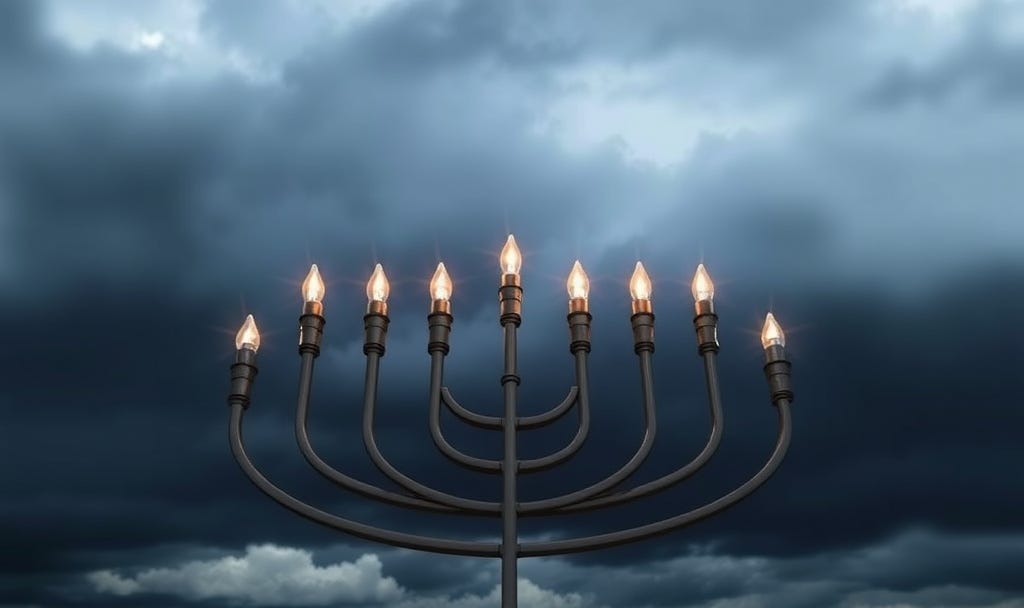
I believe we are in Satan’s Little Season, a short time where God has allowed Satan loose to deceive the nations. And of course Satan has but a short time to gloat, in an evil way about death which he appears to be celebrating. Giant “nine candle” Menorahs have been set up across Ukraine, and at least one in Gaza. The people that set up these Menorahs typically reject Jesus Christ, thus they are Antichrist and have claimed victory over the dead. The Jewish population in Ukraine is ~.1% and basically zero in Gaza. This is a spiritual analysis:
The big menorahs in Ukraine and Gaza are being used as symbols and propaganda-signs of “light in darkness,” not literal blood‑sacrifice altars, but they absolutely function as public worship to a god who has rejected the Lamb, which is spiritually serious. This particular menorah stands for “light in darkness”:
“Light” language is not neutral in Scripture
In the Bible, light is never just aesthetics or optimism, it’s authority, revelation, and worship. That’s why Paul gives this warning:
“For Satan himself transforms himself into an angel of light.”
— 2 Corinthians 11:14
Whenever someone claims to bring light into darkness, the immediate biblical instinct is not “that sounds nice,” but: Which light? By whose authority? Pointing to whom? That instinct is biblical discernment, not paranoia.
Lucifer’s original deception was counterfeit light
Isaiah 14 and Ezekiel 28 show that Satan’s fall was not about ugliness or chaos, but it was about self-exalting brilliance. Lucifer did not say, “I will bring darkness”, but he said, in effect: “I will ascend”, “I will be like the Most High”, and “I will shine.”
The danger is not darkness pretending to be darkness, but it is darkness presenting itself as light, hope, healing, and unity.
What they are on the surface
In Gaza, Chabad/IDF soldiers erected ~15‑foot menorahs at bases and in ruined neighborhoods specifically “to bring a little bit of light” and celebrate Hanukkah with soldiers.
In Ukraine, huge public menorahs (like the 39‑foot one on Kyiv’s Maidan and others in squares/malls) are framed as symbols of hope, “light vs darkness,” and national resilience during war.
Menorahs are being raised in Ukraine, with public menorah lightings and parades organized in various cities, especially during Hanukkah, to uplift the spirits of Jewish communities amid the ongoing war. These events are attended by community members and local dignitaries, emphasizing solidarity and resilience.
Menorah lightings are actively taking place across Ukraine. This year marks the first time since the war began that public menorah lightings and parades are being organized in various cities. These events are attended by Jewish communities and local dignitaries, emphasizing solidarity and resilience.
Distribution of Menorahs
Tens of thousands of menorahs are being distributed to Jewish families throughout Ukraine. Community organizations are ensuring that each household receives a menorah along with essential supplies. In major cities, large menorahs are being lit in public squares, often attended by local officials and community members. These gatherings are held under heavy security due to ongoing safety concerns.
So at the visible level, these are Hanukkah candelabra—nine‑branched hanukkiot—meant to mark a Jewish feast about temple rededication and victory over pagan oppressors, not new animal sacrifices.
The deeper spiritual issue
Hanukkah itself celebrates a second‑temple story that never accepts Jesus as the true temple and final sacrifice; public menorahs proclaim fidelity to that system (or a modern, nationalistic version of it).
When such symbols are planted in war zones, amid rubble in Gaza, amid bombed-out Ukraine, and wrapped in language of “our light conquers the darkness,” they become liturgies of covenant identity and moral justification for the war effort.
From a New Testament lens, any worship that centers ethnic covenant, nation, or law while refusing the crucified Messiah is a rival altar in the spiritual war, even if no blood is being poured on it.
How this fits into this season
These are not neutral decorations but public claims of which god is in charge of the battlefield. That’s accurate: both in Ukraine and Gaza they are consciously used as banners of religious legitimacy and “rightness” in the conflict.
In a “little season” frame, such displays help fuse politics, ethnicity, and religion into one narrative of “our sacred cause,” which can harden hearts against repentance and against the true Light of the world.
They’re not sacrificial altars in the Levitical sense, but they are overt acts of worship in contested spiritual space as candles lit to a story that does not acknowledge the once‑for‑all sacrifice, right where the nations are bleeding.
Which god
What I see is a large celebration in two war torn regions where the population (Jewish), does not support the symbol, (menorah) that is being displayed. The major religion in Ukraine is Christian (~85%), and Gaza is Muslim (~99%). This is a spiritual war, as dead Christians and Muslims are not honored by the Menorah.
The nine branched menorah is not ordained by the God of the Bible. Is nine a significant number in some other way:
The number 9 is sometimes associated with Satan in certain esoteric beliefs, where it is considered the number of pride and self, as it returns to itself in mathematical operations. Additionally, some traditions link it to various mythological and spiritual concepts related to pride and the ego.
Numerological Significance
The number 9 is often linked to various esoteric beliefs, including those in Satanism. It is considered significant because it returns to itself in mathematical operations. For example:
9 x 1 = 9
9 x 2 = 18 (1 + 8 = 9)
9 x 3 = 27 (2 + 7 = 9)
This property is seen as a representation of the ego and self, which are central themes in some Satanic philosophies.
Symbolism in Satanic Beliefs
In certain interpretations, 9 symbolizes pride and self-assertion. It is associated with the idea of returning to one’s core identity, which is a concept explored in various Satanic texts. The number is also linked to the concept of the “Black Flame,” representing individualism and enlightenment.
Cultural and Mythological Context
The number 9 appears in various mythologies and religious contexts, often symbolizing completeness or finality. In some traditions, it is connected to pride and power, which aligns with certain Satanic views. For instance, in Qabalah, 9 is seen as a number of light and truth.
Conclusion
While the number 9 is not universally recognized as “Satan’s number,” it holds significant meaning in some esoteric and Satanic traditions, often representing themes of pride, self, and completeness.
The people claiming these battlefields are Antichrist. They deny Jesus, they worship a state flag of Remphan (their God), and they violate God’s command of the seven candle lamp stand by using the nine branch lamp stand.
“And thou shalt make the seven lamps thereof: …” Exodus 25:37
“Yea, ye took up the tabernacle of Moloch, and the star of your god Remphan, …Acts 7:43
Jesus clearly said in several ways that these people do not worship the God of Abraham, and do not believe the first five books of the Bible:
What Jesus actually said
“If you believed Moses, you would believe me, for he wrote of me. But since you do not believe what he wrote, how are you going to believe what I say?” (John 5:46–47).
He adds that Moses, the one in whom they “set their hope”—will accuse them, because Moses’ writings point straight to Christ and they refuse Him.
So, in Jesus’ own logic:
True belief in Moses → inevitable belief in Jesus.
Rejection of Jesus → proves they do not really believe Moses, even if they sit under his books every Sabbath. (1st five books of the Bible)
What this implies about “claiming” Abraham’s God
Many modern Christian writers conclude: Jews of Jesus’ day said they trusted Moses and worshiped the one true God, but Christ says their refusal of Him shows they do not actually know or submit to that God.
The same argument carries forward: if God has definitively revealed Himself in Jesus, then to deny the Son is to deny the Father, no matter what name you use (Abraham’s God, God of Moses, etc.).
In other words, Jesus Himself strips the Pharisees’ claim. If they don’t believe Moses’ witness to the Son, their claim to the God of Abraham is hollow. Jesus also said:
Revelation 2:9: “I know thy works, and tribulation, and poverty, (but thou art rich) and I know the blasphemy of them which say they are Jews, and are not, but are the synagogue of Satan.”
Revelation 3:9: “Behold, I will make them of the synagogue of Satan, which say they are Jews, and are not, but do lie; behold, I will make them to come and worship before thy feet, and to know that I have loved thee.”
John 8:44: “Ye are of your father the devil, and the lusts of your father ye will do. He was a murderer from the beginning, and abode not in the truth, because there is no truth in him. When he speaketh a lie, he speaketh of his own: for he is a liar, and the father of it.”
From a Christian perspective, Talmudic/rabbinic Jews intend to worship the God of Abraham, Isaac, and Jacob, but in rejecting His Son they have effectively turned away from the true God toward a distorted, post‑biblical construct, not consciously to El or Remphan.
El, Remphan, and the biblical God
El (Canaanite): In Ugaritic texts, El is the gray‑bearded high god of the Canaanite pantheon, father of the gods, distinct from Baal and the rest.
Israel’s Scriptures use the word El/Elohim as a title/name for the true God, but they explicitly reject the Canaanite pantheon; the prophets constantly attack Israel for drifting toward Baal and the gods of the nations.
Remphan/Rephan: In Acts 7:43, Stephen cites Amos and rebukes Israel for carrying “the star of your god Rephan,” a planet‑Saturn deity linked with astral worship (sun, moon, stars).
So El and Remphan are real pagan referents in Israel’s history, but biblically they are condemned intrusions, not the true God Himself.
Modern rabbinic Judaism (Talmud)
Modern Judaism sees itself as worshiping the same God as Moses, but it rejects the New Testament and Jesus as Messiah, and relocates authority into oral law, Talmud, and later mystical streams like Kabbalah.
Some Orthodox critiques note that contemporary Judaism’s heavy dependence on Talmud/Kabbalah amounts to a different religion than Temple‑centered Old Testament faith; one convert even calls much of practical Kabbalah “sorcery.”
Theologically, that means:
They name the God of Abraham.
But by refusing His revelation in the Son (John 5:45‑47), they do not relate to Him.
So who are they actually worshiping?
Christian analysis usually frames it this way:
Jews who reject Christ are either worshiping the one true God falsely or effectively worshiping a false god under His name, because they deny His decisive self‑revelation in Jesus.
Scripture associates this pattern with the same spiritual drift that once led Israel to Molech, Baal, and the “star of your god Rephan”: mixing the name of Yahweh with practices and beliefs He never commanded.
I don’t know if they are consciously worshiping El or Remphan today; rather, their system has become a Christ‑rejecting, post‑Temple, text‑plus‑mysticism construct that leaves the Father inaccessible (since He is only known through the Son). In a “little season” lens, that makes it an especially powerful vehicle for deception: it claims Abraham’s God but refuses Abraham’s Seed.
Spiritual Warfare, Bloodshed, and the Question of Satan’s Binding
If Satan were truly bound in the present age, the scale and nature of global bloodshed would be difficult to explain. Wars today are not merely conflicts between trained armies; they increasingly involve the coercion of civilians, the elderly, and the unprepared, which are sent into battle with little hope of survival. Such acts do not reflect restraint, justice, or righteousness, but desperation and sacrifice. This raises a serious spiritual question: who benefits from this bloodshed?
Scripture repeatedly associates Satan with death, deception, and the shedding of innocent blood. Jesus called him “a murderer from the beginning” (John 8:44), and Revelation portrays a period when deception returns to the nations after a time of restraint. If we are living in such a season, then modern conflicts may not be random political failures, but manifestations of deeper spiritual allegiance.
In the Middle East, religious symbolism is inseparable from political action. Rituals, sacred objects, and ancient aspirations are openly referenced, especially by groups seeking to restore a physical temple while rejecting the Messiah who fulfilled it. The Bible warns that religious systems which claim Abraham while rejecting Christ are not aligned with God, regardless of their outward piety. John records Jesus’ own words to the religious authorities of His day, declaring that their spiritual father was not God, but the devil.
Revelation reinforces this warning by identifying a group that “says they are Jews and are not,” calling them a synagogue of Satan, not as an ethnic accusation, but as a spiritual diagnosis. Their defining mark is not lineage, but opposition to Christ and participation in deception. Throughout Scripture, bloodshed connected to false worship is condemned, from Cain onward. God never delights in sacrificial violence that flows from rebellion rather than obedience.
The desire to restore an earthly temple, while denying the true Temple of Jesus Christ, reflects a return to shadows rather than substance. Hebrews makes clear that Christ’s sacrifice ended the need for blood rituals. Any system that seeks renewed bloodshed, whether literal or symbolic, stands in direct contradiction to the Gospel.
Therefore, the issue before us is not race, nation, or ethnicity, but spiritual allegiance. History shows that when religious power aligns with political force and rejects God’s Son, the result is oppression, violence, and death. Such systems do not serve life; they serve the accuser.
If Satan were truly bound, these patterns would not be escalating. Their presence suggests not divine order, but permitted deception of testing hearts, revealing loyalties, and separating truth from counterfeit faith. As Scripture warns, deception will be so strong that even the elect would be deceived, if it were possible.
Recap
The Menorahs erected in these war torn areas make a statement in this short season, and the statement is not from the one true God. Symbols have meaning, and in this case appear to celebrate the death of Christian and Muslims killed in a war, a spiritual war.
But if thine eye be evil, thy whole body shall be full of darkness. If therefore the light that is in thee be darkness, how great is that darkness! Matthew 6:23
https://therantichrst.blogspot.com/2025/11/vote-antichrist.html